

You might be called into a meeting with HR or a line manager, without being told what it is about. Or you are attending a routine meeting like a regular one to one. It’s reasonable to assume that this will be a casual conversation. When you arrive at the meeting you might be told you are having ‘a protected conversation’.
- What is a protected conversation?
- When are they used?
- Is my job at risk if I have been called to protected conversation?
- What are the risks of a protected conversation?
- How can you find out if you are being invited to a protected conversation?
- What can you do if you find yourself having a protected conversation?
- What if you are concerned by what is happening in a protected conversation?
- Can a protected conversation be to your benefit?
- Further posts on employment rights

What is a protected conversation?
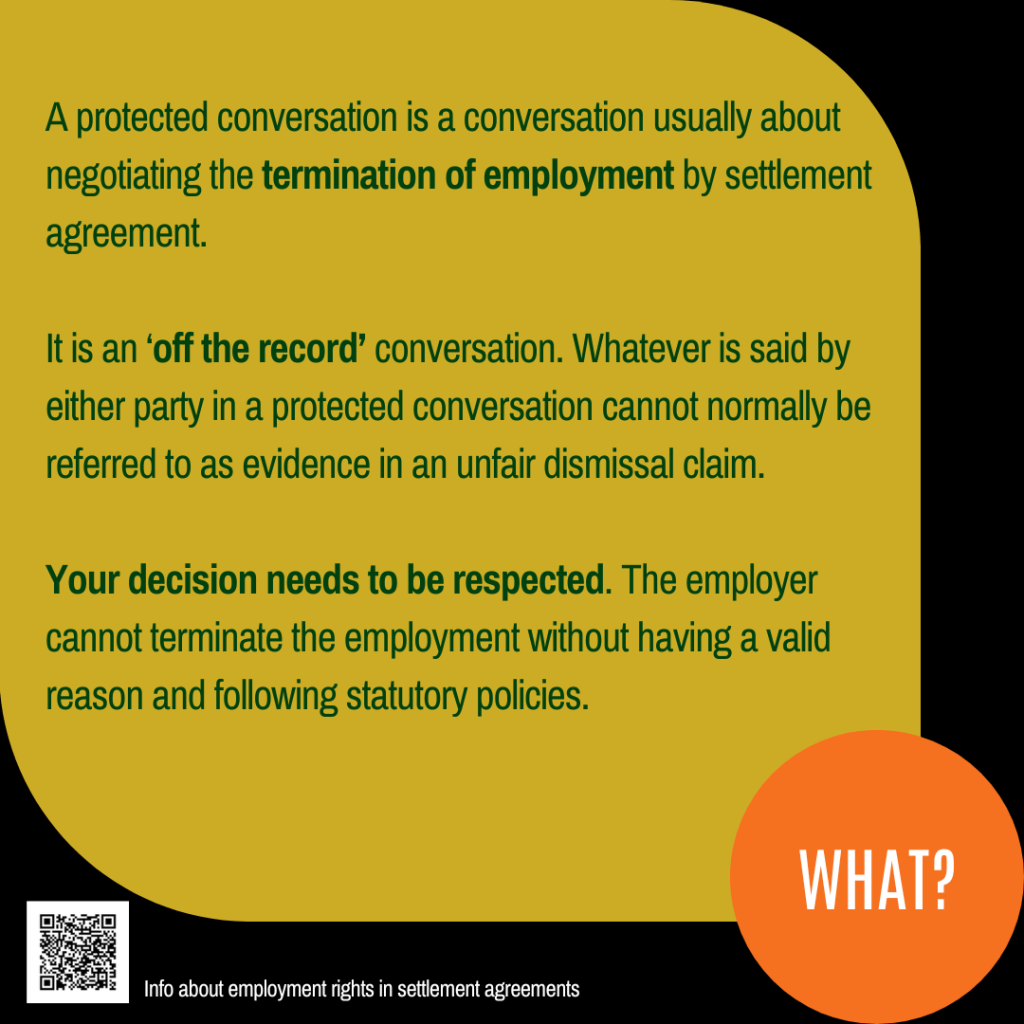
A protected conversation is a conversation usually about negotiating the termination of employment by settlement agreement.
It is an ‘off the record’ conversation. Whatever is said by either party in a protected conversation cannot normally be referred to as evidence in an unfair dismissal claim (although what is said can be used as evidence in other types of claim, such as wrongful dismissal or breach of contract claims).
The legal terms of protected conversations, also known as ‘pre-termination settlement negotiations’, are set out in section 111A of the Employment Rights Act 1996. Further information about how to understand these terms can be found in this ACAS guide on settlement agreements.
ACAS recommends employers follow best practice policies around settlement agreement discussions and allow representation (although not statutory requirement in this instance).
When are they used?
Protected conversations are most commonly used when HR or management want to explore the possibility of a settlement, usually with a view to ending your contract of employment.
Employers do not need to tell an employee in advance that they are going to have a protected conversation.
Is my job at risk if I have been called to protected conversation?
Sometimes protected conversations are used to resolve a pre-existing dispute between the employer and the employee, but other times there is no known pre-existing dispute. If you reject a voluntary exit, your decision needs to be respected. The employer cannot terminate the employment without having a valid reason and following statutory policies.

What are the risks of a protected conversation?
When a protected conversation is offered in lieu of transparent processes there is no EDI assessment.
Protected conversations can be used to avoid longer HR processes (such as disciplinaries), or in place of open, collective consultation.
The existing law and practice of protected conversations most often benefits the employer. As an employee, you might feel disempowered and uncertain on suddenly finding yourself in a conversation about a settlement agreement to terminate your contract.
How can you find out if you are being invited to a protected conversation?
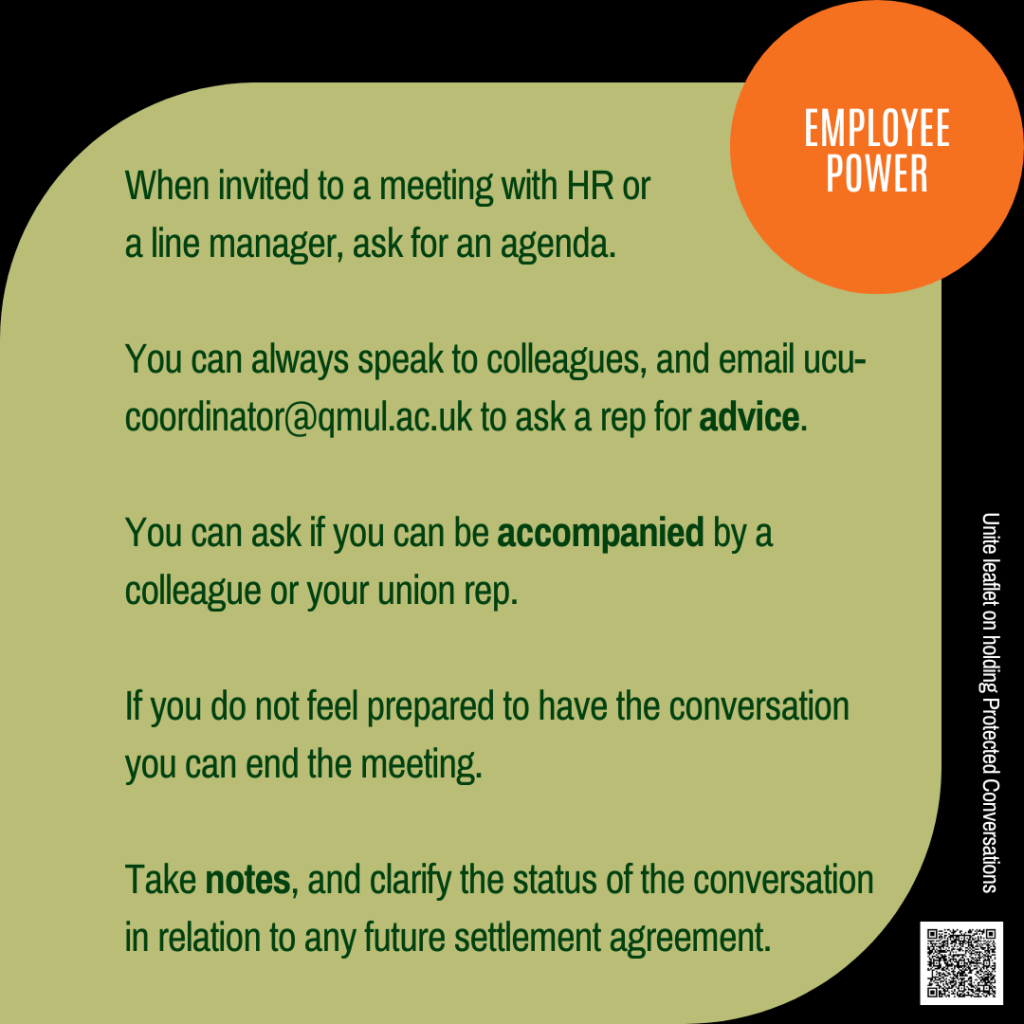
When invited to a one to one meeting with HR or a line manager, always ask in advance for an agenda and if anyone else will be attending.
If you are unsure about what the agenda refers to, you can always speak to colleagues, and email ucu-coordinator@qmul.ac.uk to ask a rep for advice.
If whoever proposed the meeting cannot confirm that this will be an informal one to one, you can ask if you can be accompanied by a colleague or your union rep.
What can you do if you find yourself having a protected conversation?
If you do not feel prepared to have the conversation you can end the meeting.
If you want to have the conversation make sure you take notes, and clarify the status of the conversation in relation to any future settlement agreement. You can also negotiate by giving them a counter-offer if you wish to exit the employment. Anything discussed in the meeting will need to be validated by signing the settlement agreement and receiving legal advice.
What if you are concerned by what is happening in a protected conversation?
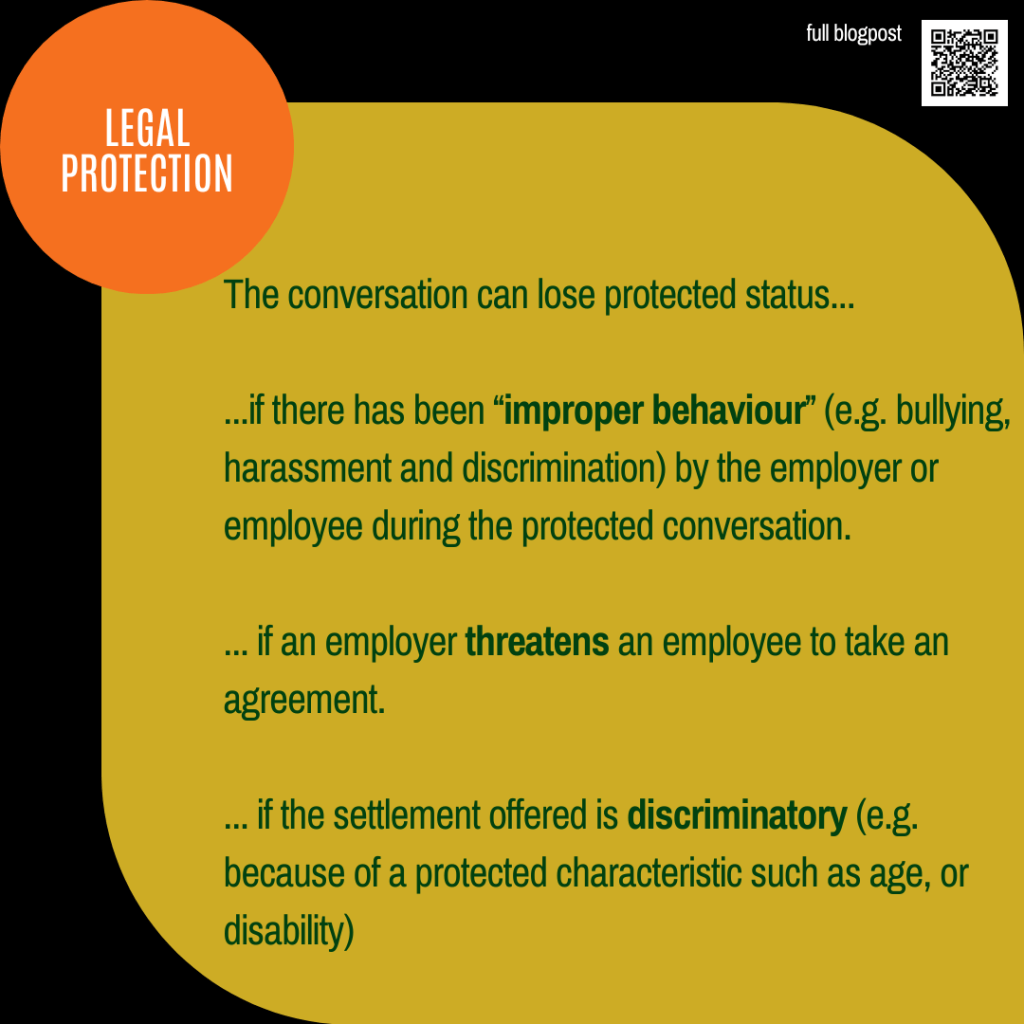
If there has been “improper” behaviour by the employer or employee during the protected conversation, the protection may be lost. Improper behaviour includes bullying, harassment and discrimination.
If an employer threatens an employee to take an agreement, the conversation is not protected.
If the settlement being offered is discriminatory (e.g. because of a protected characteristic such as age, or disability), the conversation is not protected.
Can a protected conversation be to your benefit?
Sometimes employees may request a protected conversation in order to discuss possible terms of a settlement agreement.
You can find out more about how to have a protected conversation from this Unite information sheet.
Further posts on employment rights
- changes to employment rights in April 2024
- Settlement agreements an voluntary redundancy
 qmucu.org
2 thoughts on “Meetings with HR and line managers”
Comments are closed.