

As every announcement of further cuts, restructures, and redundancies repeats: the university sector is not in great shape. While there are genuine deficits in some universities, in others, the reference to external forces serves as a deflection of responsibility and a cover for cuts that are more ideological than necessary.
QMUL management frequently declares that the university is in good financial health. After all, they recently bought a plot of land that last changed hands in 2016 for £77 million. At the same time, they say they have no choice but to repeatedly make staff cuts in Professional Services, the humanities, IT services, student experience support, and estate and facilities. The staggered and often surreptitious implementation of these cuts studiously avoided press headlines. And yet, the gradual erosion of our working conditions and staff resources might be less visible than one headline number, it is not less felt for it.
- Since September the union reps have been presented with 12 restructure papers for organisational change with risk of redundancies across departments and services; this is beyond anything in our collective memory.
- Management have to notify the government and union reps if there is a risk of more than 20 redundancies in a 3 month period. SET has taken a strategy of breaking down which avoids a reckoning with the actual number of jobs cut. But even then, over the last 3 months, there have been over 90 posts at risk of redundancy.
- The plans put forward in the rushed reorganisation of Professional Services are leaving too lean a coverage. When staff point out that no department can be run like that, they receive the response that ‘new technology’ and ‘academic self-service’ will plug gaps as some existing PS tasks will ‘cease’.
- Academics in the School of the Arts and the School of History and School of Geography have received targeted emails notifying them of the reopening of the Voluntary Severance Scheme only for their roles, putting pressure on them to leave.
- HR has been using the existing capability and probation processes to dismiss members of staff and trigger stealth exits, raising questions about their application of policies. We have seen an uptick in the use of protected conversations with a threat of formal processes.
Together, all of this adds up. By our rough estimation over the last two years, well over 200 roles have been terminated and jobs lost through ‘voluntary’ and compulsory measures: approx 60 VS last year, 80 VS PS this year, 50 VS academic this year; strategic exits; redundancies in restructures. None of these posts are coming back.
200 posts lost, that is a headline management has tried to avoid seeing in print.
Headline or not, this is a huge cut to the services of the institution, a great loss of colleagues, and a great loss for those who are left worried about their own job and also about their working conditions.
There is no financial need for QM to be rushing through restructures at the cost of jobs and unsafe workloads for those who stay. Management is spending lavishly on matters that aren’t staff, such as on a plot of land in Whitechapel last sold for £77 million (and its multi-million annual upkeep), and external consultancies. As a recent FOI showed, just in the past 5 years, the university spent at least over two million on external consultancies. Nearly £600,000 of that went to Deloitte to sort ‘change management’ for Professional Services – in other words: the 20-25% cuts to Professional Services that are currently being pushed through. The quarter million to QS still didn’t get us back in the top hundreds of the QS rankings. Other FOIs showed management has already spent over £435,000 on NOUS, while denying having a contract with them.
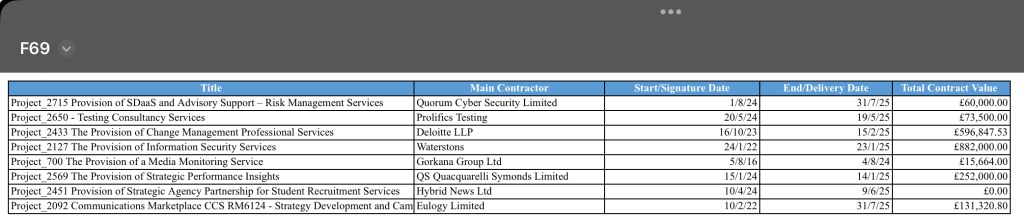
Where management spends is a political choice. And we keep the pressure on to ensure staff isn’t an afterthought.
- Our consultative ballot on job protection had a 54% turnout. 87.6% of that turnout voted for industrial action. Jointly organised with Unison, they also had a big turnout voting in favour.
- The ballot is already making a difference for members affected by the ongoing Transformation by a 1000 cuts, for it puts management under pressure in negotiations of settlements.
- Despite management not agreeing to no compulsory redundancies, consultations and counter-proposals from staff have somewhat mitigated the individual impact and helped people leave with settlements and packages.
- We will continue to push for negotiations over job protection principles.
Related:
 qmucu.org

One thought on “Stealth redundancies & staggered cuts”
Comments are closed.